
Proof of life
- Column Top Stories
ABcontributor
- 0
- 19 minutes read
By Satish Jha
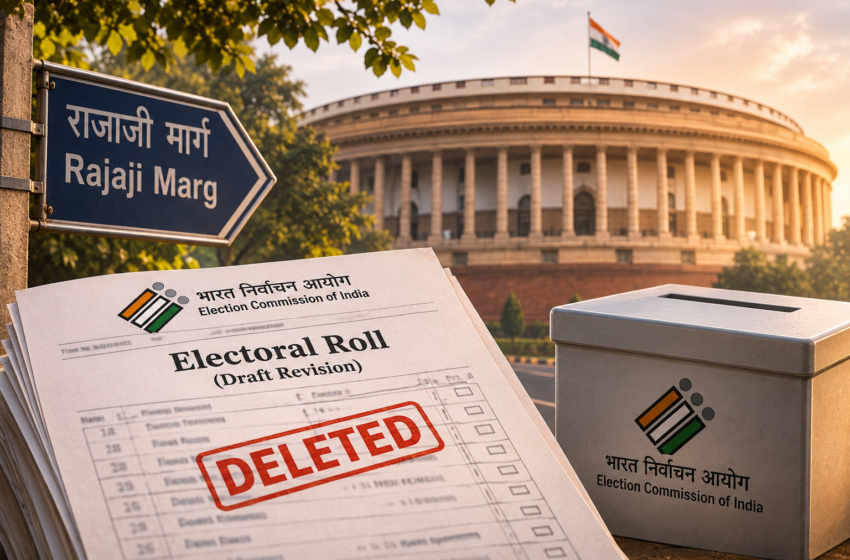
Kamta Prasad is fifty-three years old and a tailor in Delhi. He has voted, by his own account, for thirty-five years. In 2026 the revision of Delhi’s electoral roll recorded him as dead. Since then he has gone from one government office to the next to establish that he is not, and every day spent in a queue is a day without the 250 rupees on which a family of four depends. Officials have told him his name will be restored. A volunteer with a local non-profit estimates that in his block roughly 2,000 of some 9,000 voters were struck off. Across Delhi, the draft rolls removed 4.2 million names. Across the country, Reuters puts the number removed under the revision at around 130 million.
India has seen a living man declared dead before. In 1975, in Azamgarh district of Uttar Pradesh, an uncle bribed an official to record Lal Bihari as deceased and took his land, a plot of less than an acre. It took Lal Bihari nineteen years to be declared alive again. Along the way he added the word Mritak, the dead, to his own name, and founded an association of people the state had buried while they still breathed. That was one official, one bribe, one small plot of land. What the revision has done is the same act at the scale of a nation, and whether by error or by design, the burden has fallen where it fell on him: on the living.
The republic began with the opposite wager. In the winter of 1951, India’s first Chief Election Commissioner, Sukumar Sen, set out to ask 173 million people, more than seven in ten of whom could not read, to trust a box. No election on that scale had ever been held anywhere. So he improvised. Each candidate got a ballot box of his own, painted with a symbol that a voter who could not read would still know. The voter, alone behind a screen, dropped a slip of paper into the box of his choosing. The whole apparatus of the first general election rested on one wager: that the poorest citizen would believe the slip he dropped would be counted, and counted as he meant it.
READ: The Politics of Promises: Kerala’s Senior Citizens Act and the Expanding State Bureaucracy (October 28, 2026)
They believed. That belief, more than any article of the Constitution, is the ground on which the Indian republic was built. It was never written down. It never needed to be. Seventy-five years later, it is the one thing the Election Commission of India cannot manufacture, cannot requisition from the state, and cannot replace once it is spent. It is being spent. This essay asks a narrow question with a wide answer: how a free people removes a referee it is not permitted to fire.
The framers knew what they were guarding. Article 324 gave the Chief Election Commissioner the armour of a Supreme Court judge. He can be removed only for proved misbehaviour or incapacity, only after an inquiry, and only by a special majority of both Houses of Parliament. The armour was forged against one danger: a government that wished to rid itself of an inconvenient referee. It was not forged against a quieter danger, a government that would never need to remove the referee, because it had chosen him.
That is what came to pass. In March 2023, the Supreme Court, troubled that election commissioners were being picked by the government alone, placed the Chief Justice of India on the selection panel beside the Prime Minister and the Leader of the Opposition, until Parliament made a law. Parliament made one within the year. It removed the Chief Justice and seated in his place a Union minister nominated by the Prime Minister. Two votes to one. The government now selects the officer who certifies whether the government has won.
The first draft of that law went further. It proposed to pay the Chief Election Commissioner as a Cabinet Secretary rather than as a judge of the Supreme Court: the highest bureaucrat in the land, but a bureaucrat, an officer who reports upward. After an outcry the clause was withdrawn. It deserves to be remembered all the same, because it was the government telling the country, in the plain language of a pay scale, what it believed the office to be. The Constitution gave India an umpire. The law of 2023 gave it a nominee.
In February 2025 the new panel met to choose. The Leader of the Opposition recorded a dissent and asked that the decision wait for the Supreme Court, which was hearing a challenge to the new law. The majority of two did not wait. The name was announced close to midnight. Gyanesh Kumar became the first Chief Election Commissioner chosen by the very people he would be asked to referee.
What followed is a matter of record, and the record is the point. When the revision of Bihar’s rolls in 2025 dropped some sixty-five lakh names from the draft list, the Commission offered aggregate reasons and maintained it was not legally bound to name the excluded. It published the names, booth by booth, with reasons, only when the Supreme Court ordered it to. Days later, when the Leader of the Opposition alleged that rolls had been manipulated, the Chief Election Commissioner gave him seven days to swear an affidavit or apologise to the nation. There is a version of that demand an honest referee could make: the version made by an official who has already published everything. A referee who demands sworn testimony from a player while refusing the crowd a look at the replay has stopped refereeing the match. He has joined it.
The numbers have faces. On Aug. 12, 2025, the activist Yogendra Yadav brought into the Supreme Court two people whom the draft roll listed as dead. One of them, Mintu Paswan, stood before the bench and described the asymmetry he had discovered: his name had been struck off without a single document being asked of him, and to restore it he was now asked for bank papers, school certificates and his Aadhaar card. The Commission’s counsel called the demonstration a drama. The bench, more gently, called it an inadvertent error that could be put right. Both may be true of one man. Neither is an answer for a roll from which sixty-five lakh names had been struck, because a system that can kill a living citizen by clerical error, and then require him to prove he is alive, has turned the burden of the republic upside down. The state once had to show why a man could not vote. Now the man must show that he exists.
Bihar was the first state, not the last. In West Bengal, by March 2026, 63.66 lakh names had been deleted and another 60 lakh sent for adjudication; twenty-two voters the Commission had recorded as dead sat beside the Chief Minister at a protest in Kolkata to show that they were not. In Karnataka, the Commission’s lists of absent, shifted, dead and duplicate voters named about 1.08 crore people, a fifth of the 2023 electorate. A preliminary study by the Sabar Institute found that eighty-five per cent of them were listed for reasons other than death, and that in 145 of the state’s 224 constituencies those non-death deletions exceeded the last winning margin; its authors were careful to say that this does not prove any result would have changed. The Commission’s position throughout has been that it is removing the duplicate, the dead and the departed, and that anyone struck off in error may claim restoration. Many of those removed surely were exactly that. But a revision that must be corrected by its victims, one queue at a time, has placed the cost of its errors on the people least able to pay it.
The record now has a roll call of its own. In Raghopur, Bihar, seven voters, Ramikbal Ray, Harendra Ray, Lalmuni Devi, Vachiya Devi, Lalwati Devi, Punam Kumari and Munna Kumar, whom the Congress said were alive and had filed their papers, were listed among the dead. In Delhi, Kamal Lal, a schoolteacher, was marked as shifted though he still lives under the same flyover with dozens of other families. On the last day of October 2026, at the people’s impeachment held on the lawn of the Congress president’s residence, Kunne Lal of the Lal Gumbad settlement, recorded as dead, said no booth-level officer had ever come to his door; Shashi Tharoor remarked that he spoke very convincingly for a corpse. Anita Jaiswal, a single mother who has voted since 2012, told the same gathering that her deleted voter card had been the thread holding together her court case, her bank account and her daughter’s scholarship. From Bijapur, Waheed described producing living voters before the deputy commissioner, documents in hand, and watching their names stay off the final roll. These are not statistics rounded for effect. They are the people the statistics are made of.
By September 2026 the doubt had reached the table itself. Fourteen times in ten months, The Indian Express reported, the Commission’s two other members had questioned how the roll was being revised. Fourteen objections, and the country learned of them from a newspaper. The dissent had a chair at the table and no voice outside the room.
The Commission did not travel this road alone. For twelve years, Narendra Modi’s government has governed India’s institutions by a single method: not abolition, which provokes, but appointment, which does not. The Commission itself has seen both halves of that method. In 2019, Election Commissioner Ashok Lavasa dissented when his two colleagues cleared the Prime Minister and the Home Minister of complaints under the model code of conduct. In the months that followed, his wife, his sister and his son came under the scrutiny of the income-tax department. He had been next in line to become Chief Election Commissioner. In August 2020 he resigned, for a post at the Asian Development Bank. In November 2022, Arun Goel took voluntary retirement from the civil service and was appointed Election Commissioner the next day; the Supreme Court asked aloud why his file had moved at lightning speed. Beyond the Commission, Ranjan Gogoi retired as Chief Justice of India in November 2019 and was nominated to the Rajya Sabha four months later. Each of these has an explanation on file. Together they describe a pattern: dissent made expensive, proximity made rewarding.
A government is best measured by the distance between what it promised and what it delivered. On 15 August 2014, at the Red Fort, Narendra Modi told the nation that he stood before it not as its pradhan mantri but as its pradhan sevak, its prime servant. That same month, his government asked every ministry and every state to let citizens certify their own documents, so that the poor would no longer have to pay, in money and in time, for a gazetted officer to vouch for them. It was a good promise: the state would trust the citizen’s word. Twelve years later the burden it promised to lift has returned, heavier than before. The revision has removed some 130 million names, and the citizen who wants his back must once again prove himself before an official, the very indignity the government had promised to end.
West Bengal shows what that reversal costs. Of the 60 lakh voters sent there for adjudication, some 27 lakh were ruled ineligible days before the assembly election of April and May 2026. The Supreme Court ordered appellate tribunals to hear them. By August, according to an RTI reply, the tribunals had decided about 82,000 appeals, barely two per cent of the 38 lakh before them, and in 91 per cent of those decided the voter’s name was ordered restored. Some twenty lakh of the excluded never appealed at all, and the fifteen-day window to do so has closed. When nine of every ten wrongs that reach a judge are found to be wrongs, the question is no longer whether the machine makes errors. It is who is made to pay for them.
A prime servant who makes his masters queue to prove they are alive has stopped serving. He governs like an emperor India never had, one who rules not by decree but by deletion. Where the distance between promise and performance is this wide, it is never left empty. It is filled with noise, with spectacle and slogans and the steady insistence that the country has never been stronger. A government confident of its ledger publishes it. A government that fears its ledger appoints the auditor.
READ: Ro Khanna wins Democracy Award for best Workplace Environment (August 14, 2023)
The Constitution’s remedy for a compromised Chief Election Commissioner has now been tried and found locked. In March 2026, 130 members of the Lok Sabha and 63 of the Rajya Sabha signed notices for his removal. In April, the Speaker and the Chairman declined to admit them. The process the Constitution provides for removing a Chief Election Commissioner had never been completed in seventy-six years. It has now been shown that it cannot even begin. The courts remain open, but they move at the pace of hearings and adjournments, and an election does not wait for a judgment; a ruling that arrives after the count corrects the record, not the result. That is why the people’s impeachment of 31 October was held on a lawn: the chamber would not hear it. A republic that holds its impeachments outdoors has not lost its Parliament. It has lost the use of it.
So the question is no longer whether the man should go. It is how a man who cannot be fired is made to leave, without breaking the very things the protest exists to save.
Begin with what resignation is. Officials do not resign because they are accused. They resign when staying has become more expensive than leaving. Every strategy worth the name is a way of changing that arithmetic, and it is worth remembering that the office itself once demonstrated how much arithmetic a single man can change. In the 1990s, T. N. Seshan showed what the Commission could do when its chief wanted it to; politicians of every party came to fear Nirvachan Sadan, the Commission’s building on Ashoka Road. The office still holds every one of those powers. Only the fear has changed direction.
Turning that fear around begins with the record: not with the slogan, which hardens loyalties on both sides, and not with the unproven charge, which the accused will thank you for. Every allegation that cannot be proved is a gift to the man it accuses; every one that can be proved is a weight he must carry into every room he enters. The work is slow and unglamorous: the name deleted and the reason never given, the complaint acknowledged and never answered, the rule amended a week before it was needed, assembled booth by booth into a public account that no press conference can outtalk. Bihar has already shown that such work moves courts. A deletion that must be explained name by name is a different act from one that need only be announced.
Nor does the record stop at the Commission’s door, because the Commission is not one man. Two commissioners sit beside him, and by the reported account they have already raised their doubts, more than once. The country is entitled to ask them, respectfully and in public, to say outside the room what they have said inside it. A Chief who is outvoted in his own Commission is still in office. A Chief whose colleagues will no longer lend him their silence is in a different office altogether.
What citizens may withhold is ceremony, never the vote. Gandhi told a British court in 1922 that non-cooperation with evil is as much a duty as cooperation with good, and he meant it as a discipline, not a riot. The rituals by which a compromised office borrows legitimacy can be declined: the all-party meeting that exists to end in a photograph, the panel on National Voters’ Day, the courtesy call that allows the Commission to describe its critics as consulted. But the ballot must never be boycotted. An empty polling booth is the one verdict this arrangement could not have produced on its own, and it would be a gift. The answer to a doubtful referee is a crowd so large, and so watchful, that every whistle is heard by a million witnesses.
Part of the price will be paid abroad. India’s Election Commission has trained election officials from 141 countries; its reputation abroad was a large part of what the office was, and it can become a large part of what the office costs. When foreign commissions, observers and scholars begin to speak of Nirvachan Sadan in the past tense, the man in its chair loses something no government can reappoint him to.
Pressure alone, though, only corners a man, and a cornered man digs in. Men leave offices through doors, not through walls. In 2016, after months of street protest, Kenya’s electoral commissioners agreed to leave office through a settlement negotiated by a cross-party committee of Parliament; their chairman said the country was bigger than any of them. That sentence was the door. A movement that wants an official gone must not only make his chair uncomfortable. It must also make his exit possible, and even dignified, because a man with nowhere to go will hold the chair until it breaks beneath the country.
And here the argument must be honest about its own limit, because a movement that lies to itself is only a smaller version of what it opposes. Suppose it works. Suppose the record grows too heavy, the colleagues too audible, the ceremonies too empty, and the man walks through the door. His successor will be chosen by the same panel, by the same two votes to one. To remove the man and keep the method is to change the guard and leave the key in the same hand. The demand must therefore be two demands, joined so that neither can be granted alone: the resignation of the officer, and the restoration of a selection the government does not control. That means the panel the Supreme Court set in March 2023, the Prime Minister, the Leader of the Opposition and the Chief Justice of India, restored by amending the law of 2023 and then written into Article 324 itself, where no ordinary majority can quietly undo it. No panel is proof against capture; this essay has already recorded a Chief Justice who entered the Rajya Sabha four months after retiring. The claim is narrower: on such a panel the government holds one vote of three, and every appointment must survive a vote it cannot be sure of winning. One is a face. The other is a rule. Faces change every few years; rules outlive the people who wrote them.
It can be done, and the proof sits inside this very story. In 2023 the government proposed to make the Chief Election Commissioner a Cabinet Secretary, and the country objected, and the government retreated. In 2026, after weeks of protest over struck-off names, the Commission itself ordered fresh verification in some states, Delhi among them. Neither retreat came from conviction. Each came because the cost of staying the course had become visible. That is all pressure ever is: not a guarantee, but a price, made public and paid in instalments, until the party that is paying decides it has paid enough. It may take one election. It may take three. A republic is not repaired at the speed of outrage. Meanwhile the cost is paid elsewhere. Kamta Prasad has been paying it at 250 rupees for every day spent in a queue, and the republic pays in the same coin, one wrongly struck name at a time.
India has stood here before, and it remembers how the story ended. In June 1975 the doors were shut harder than they are now: the press was censored, the opposition jailed, the courts cowed, the Constitution amended at will. Twenty-one months later, the people of India rose. They did not rise by breaking anything. They rose by standing in line. In March 1977, a government that had closed every door discovered that it had left one open, the polling booth, and it was voted out of power by the same electorate Sukumar Sen had once asked to trust a painted box. The Election Commission counted those votes honestly. It was the republic’s proof of life. That was the whole of the miracle, and it is precisely the thing now in question.
This is what rising means in a republic, and it is worth saying plainly to anyone who would hear in it a call to anything else. A people does not rise by setting fire to its own house. It rises the way a congregation rises: together, without violence, and all at once, so that no one in the room can any longer pretend not to have seen. It rises by refusing to look away from the record, by refusing to lend its silence, and by refusing, above all, to surrender the ballot to those who have made it doubtful. A republic is not the right to vote. It is the right to have your vote counted by someone you did not have to fear.
The ink on a voter’s finger fades in a few weeks. It was never meant to last. What was meant to last was the promise it stood for: that the count belongs to the counted. Officers come and go through the gates of Nirvachan Sadan. They hold that promise in trust; none of them owns it. It was lent in the winter of 1951 by 173 million people, most of whom could not read the boxes they trusted. It is being asked back now, by Mintu Paswan before the Supreme Court, by Kamta Prasad in the queues of Delhi’s offices, by Kunne Lal on a borrowed lawn, each of them standing alive, each of them the only document that should ever have been needed. What a people has lent, a people can recall.

